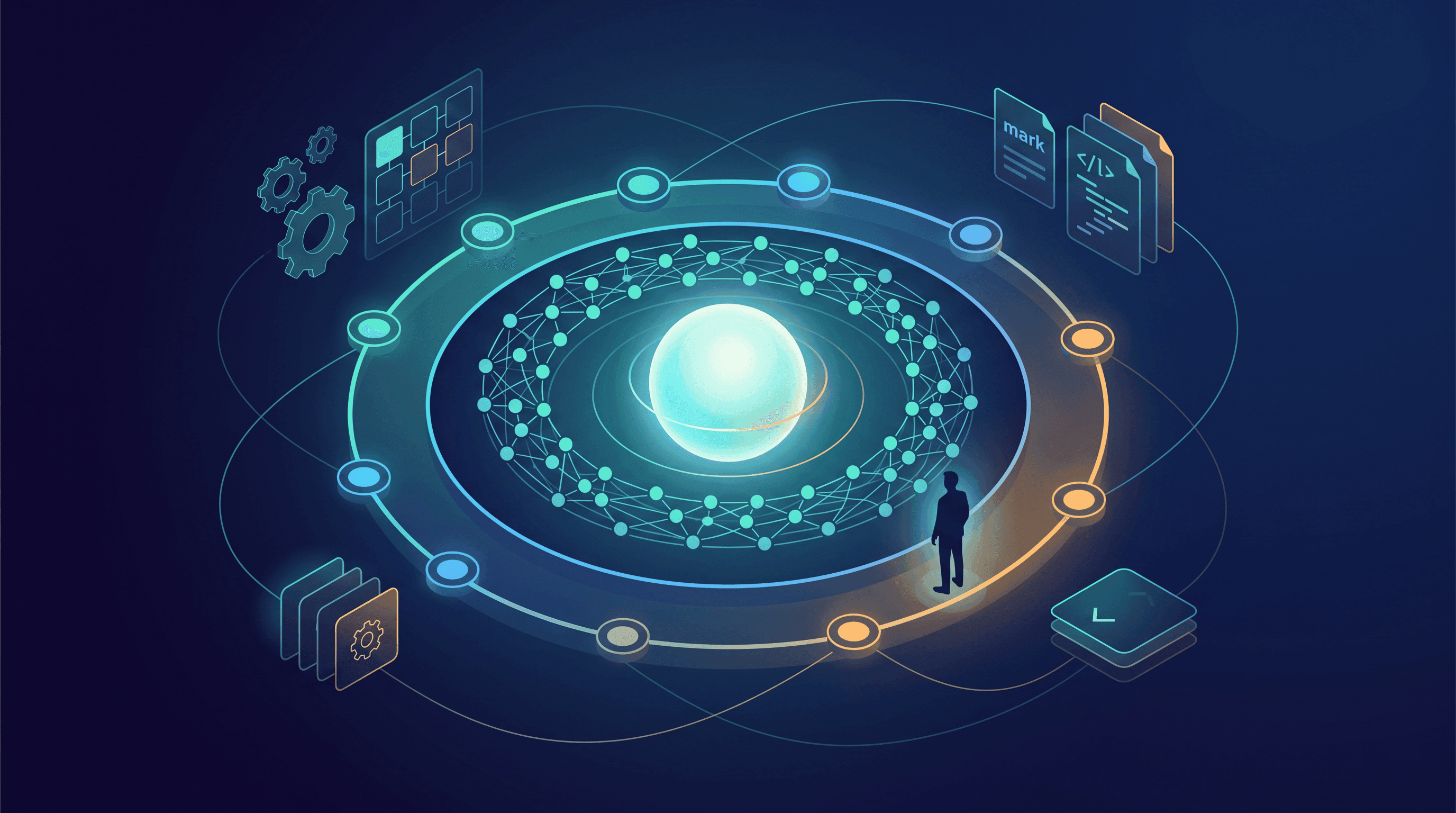
AI engineering has come a long way in three years. What started as "prompt engineering" and buzzy autonomous-agent demos like AutoGPT has matured into a serious discipline. The clearest signal in 2026: the field has moved beyond building with agents toward building the systems around them. Here are five trends shaping how teams design, deploy, and control AI agent systems today.
The biggest shift is where the engineering effort now goes. Instead of obsessing over the agent itself — its planning, memory, and tool use — attention has moved to the harness: the system that manages workflows, context, permissions, evaluation, persistent state, and continuous improvement.
Lilian Weng captured this evolution well. Her influential 2023 essay described the anatomy of an LLM agent. Her 2026 follow-up on "harness engineering" argues that the surrounding system has become just as important as the model. In practice, this means:
The lesson learned the hard way: complete agent autonomy is neither reliable nor desirable at scale. Agents are now positioned to augment engineers, not replace them. As one frontier engineer put it, models are increasingly "grown, not designed" — they gain capability in spiky, unpredictable ways, which is exactly why the system wrapped around them matters so much.
"Loops" became the buzzword of the year, and behind the hype lies a real question: how much control should agents have, and where do humans stay in the loop?
The dominant pattern is the inner loop / outer loop split:
As Addy Osmani framed it: "agents can run much more of the inner execution loop, but that outer loop is still engineering." This is where the emerging concept of autoresearch fits — a second system that studies and maintains the primary agent, closing the feedback loop for self-improvement.
There's healthy skepticism too. Critics warn that "the hype is outrunning the discipline," noting that reliable control loops (like those in Kubernetes) are deterministic — while agent loops are not yet. A memorable analogy from the conference floor: AI engineers are becoming "locomotive engineers," whose job is to keep the locomotive on the rails.
Agentic development is reaching large organizations, largely through a new role: the Forward Deployed Engineer (FDE) — engineers who embed directly with a customer to implement AI capabilities end to end.
Enterprises don't just want an agent; they want to own and maintain an entire agentic ecosystem: all the integrations, all the teams contributing to the agent, and a clear ROI that survives after the FDEs leave. The measure of success is simple — "they're not gonna turn things off when we leave."
Two recurring concepts define this trend:
The reality check: enterprise adoption is still concentrated among early adopters, so finding the right internal champions remains a real challenge.
Perhaps the biggest day-to-day change: how developers actually interact with AI. In 2023, AI assistance mostly meant autocomplete — the model finishing your next few lines. Now, coding agents like Claude Code, Codex, Gemini CLI, Cursor, and Warp can:
The trend is spreading to web development too, with frameworks that treat agents as a new type of software — less predictable than traditional web apps, with dynamic interfaces and outputs. New infrastructure needs emerged fast: sandboxes, secure code execution, and long-running jobs became critical almost overnight.
But the "factory" metaphor isn't universally loved. A counter-view argues for keeping the human in flow — "in front of an orchestra, waving my baton" — rather than managing a faceless factory. The tension between software factories vs. orchestras remains unresolved, and even loop advocates caution that these approaches are still being figured out.
The final trend is skills — reusable, declarative instructions that encode the workflows, quality gates, and best practices senior engineers use when building software. Popularized by Anthropic's "agent skills," the idea has spread across every major agent platform.
Key ideas emerging around skills:
There are pitfalls. Most skills — and most models — aren't very creative; if everyone uses the same design skill, everything starts to look the same. There's even "skills hell," echoing earlier "frameworks hell." The advice: write fewer, smaller skills and put more thought into structure. And because models keep improving, skills need maintenance — "each new model release is like a kid growing from middle school to high school; you have to change the curriculum."
Three years ago the question was whether LLMs could act as autonomous agents at all — and the answer was usually no. Now that agents not only work but scale, the conversation has moved to the harder problems: building reliable systems, orchestrating teams of agents, managing context, evaluating outputs, and integrating AI into production software.
Whether developers call themselves AI engineers, software engineers, or Forward Deployed Engineers, they increasingly share the same toolkit: coding agents, harness engineering, loop design, and orchestration. The common thread across all five trends is clear — the future of AI isn't the lone autonomous agent, but the well-engineered system built around it.